
Dental emergency in Switzerland: immediate or organized? How to make the right choice
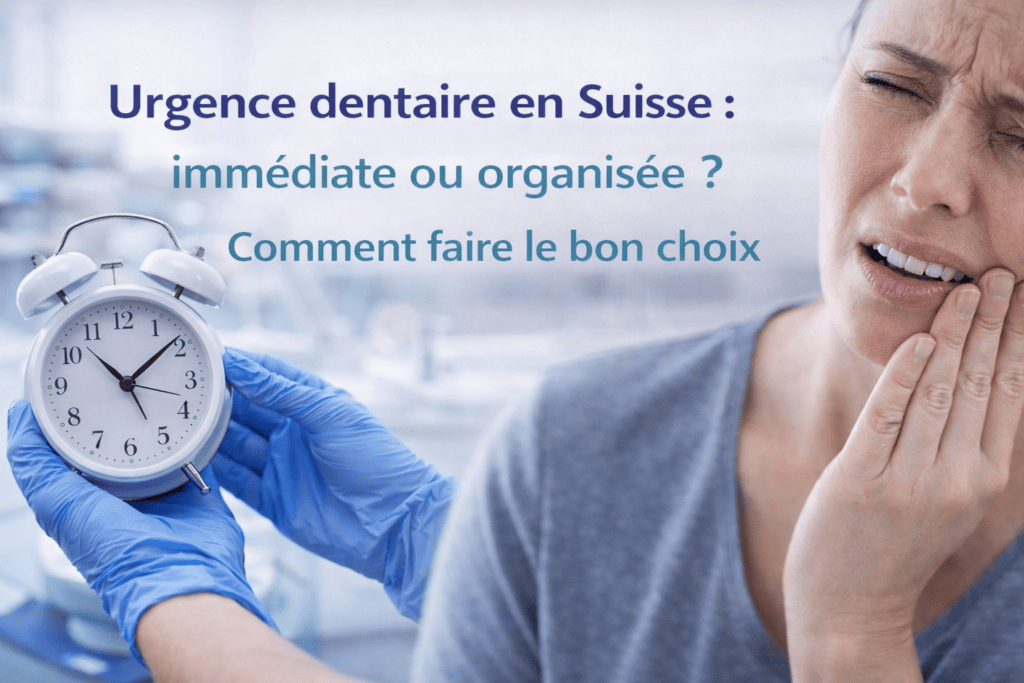
When a dental problem arises suddenly, the first reaction is often the same: wanting to act quickly.
But in dentistry, acting quickly does not always mean acting hastily.
Understanding the difference between immediate dental emergency and organized dental emergency helps make the right choice — to relieve pain, protect the tooth, and avoid more extensive treatments later.
What is a dental emergency?
A dental emergency corresponds to a situation requiring rapid assessment to avoid:
- worsening pain,
- an infection,
- irreversible damage to the tooth or surrounding tissues.
Not all emergencies are alike.
This is where the distinction becomes essential.
Immediate Dental Emergency
When is immediate intervention necessary?
Immediate care is indicated when:
- the pain is intense, uncontrollable, or persistent,
- swelling appears,
- an infection is suspected,
- dental trauma has occurred,
- general health begins to be affected.
Objective
- rapid relief,
- stabilize the situation,
- avoid acute complications.
The immediate emergency primarily aims for stabilization.
Organized Dental Emergency
When organization is more effective than haste
In many situations, the pain or incident allows for a more structured approach:
- broken tooth without intense pain,
- dislodged crown or veneer,
- progressive functional discomfort,
- intermittent or recent pain.
Objective
- establish an accurate diagnosis,
- understand the true origin of the problem,
- plan a lasting solution.
Organized emergency allows for intelligent treatment, rather than multiplying temporary interventions.
Why improvisation can cost more
In an emergency, decisions made without a complete diagnosis can lead to:
- repeated temporary care,
- unnecessary loss of tooth structure,
- an increase in overall cost,
- a loss of patient trust.
Taking the time to structure the emergency is often the most rational choice, even when the situation seems urgent.
The role of digital dentistry in emergencies
Today, digital dentistry allows, in certain well-defined cases, for:
- rapid and accurate diagnosis,
- immediate planning,
- the creation of durable restorations in a single visit.
This does not mean that everything can be done immediately, but that the emergency can be intelligently organized, with a clear vision of the treatment.
How to know which emergency applies to you?
A few simple questions can help guide you:
- Is the pain bearable or not?
- Is there swelling or signs of infection?
- Is the problem worsening rapidly?
- Is function compromised?
Professional advice remains essential to decide between an immediate emergency and an organized emergency.
Frequently Asked Questions
Does every dental emergency require same-day intervention?
No. Some situations benefit from an organized approach.
Can one wait if the pain subsides?
Pain that disappears does not always indicate a resolution of the problem.
Is a quick solution always temporary?
No. When well-planned, a quick solution can be lasting.
Conclusion
A dental emergency is not a matter of speed, but of quality of decision.
Distinguishing between immediate and organized emergencies allows for safer, more effective, and more lasting care.
At Dental Swiss Clinics, emergency is viewed as a structured decision, integrating diagnosis, planning, and digital technologies when relevant.