
Understand Before Choosing
Digital dentistry is often presented as a technological revolution capable of transforming dental care.
In reality, it is primarily a clinical tool. Powerful, precise — but not universal.
At Dental Swiss Clinics, we use digital dentistry only when it provides a real medical benefit to the patient.
Understanding when it is indicated, and when it is not, allows for an informed choice adapted to each situation.
What is Meant by Digital Dentistry?
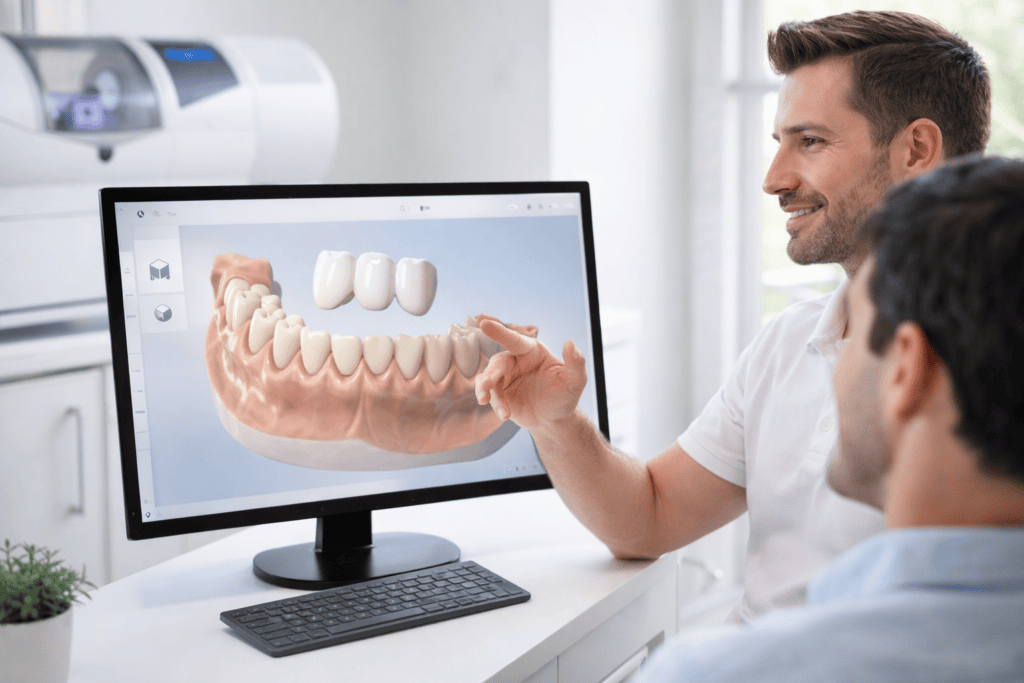
Digital dentistry relies on a digitized workflow, notably including:
- 3D intraoral scanning (without impression paste),
- computer-aided design (CAD),
- immediate in-office fabrication of certain restorations.
This workflow allows for high precision and, in certain well-defined cases, the organization of care in a single visit.
But technology does not mean automatism:
the medical indication remains crucial.
Situations Where Digital Dentistry is Particularly Indicated
Well-Defined Single Restorations
Digital dentistry is particularly suitable for:
- single crowns,
- inlays and onlays,
- certain veneers,
- custom splints (bruxism, whitening).
When the clinical situation is stable and biological conditions are met, the digital workflow allows for precise adaptation, excellent reproducibility, and a reduction in intermediate steps.
Patients with Limited Time
For some patients, the main constraint is not the treatment itself, but:
- multiple appointments,
- repeated appointments,
- prolonged temporary care.
In these situations, digital dentistry can sometimes group steps together, without compromising the quality of care, when the indication is clinically validated.
Anxious Patients or Those Sensitive to Prolonged Treatments
For some anxious patients, the reduction in:
- the number of appointments,
- the anticipation associated with extended care,
- uncomfortable manipulations (traditional impressions),
can significantly improve the overall experience.
Digital dentistry then becomes a tool for comfort, not an end in itself.
Situations Where Digital Dentistry is Not Indicated
Biologically Unstable Cases
Certain situations require:
- a healing period,
- an observation phase,
- progressive adjustments.
In these cases, trying to accelerate treatment would be counterproductive, or even medically inappropriate.
Complex Situations Requiring Multiple Phases
Treatments involving:
- significant occlusal imbalances,
- evolving periodontal pathologies,
- extensive reconstructions,
may require a sequential approach, where digital technology plays a partial role, but not as the sole solution.
What Digital Dentistry Does Not Replace
Technology never replaces:
- clinical examination,
- medical diagnosis,
- biological analysis,
- the practitioner’s experience.
It assists decision-making; it does not make the decision.
A Question of Indication, Not Promise
The most common mistake is to think that digital dentistry is:
faster in all cases
In reality, it is:
- more precise when indicated,
- more effective when used appropriately,
- safer when biological constraints are respected.
How to Know if Digital Dentistry is Right for Your Situation?
Only a personalized clinical evaluation can determine if:
- digital care is indicated,
- a single-visit organization is possible,
- or if a more progressive approach is preferable.
Each situation is analyzed individually, without automatism.
Key Takeaways
- Digital dentistry is a medical tool, not a universal standard.
- It is particularly indicated in certain well-defined cases.
- It is never used to the detriment of biology or safety.
- The quality of care depends primarily on the diagnosis and indication.
If you are in doubt, a consultation can prevent complications from developing. Cabinet dentaire à Montreux : Dental Swiss Clinics.