
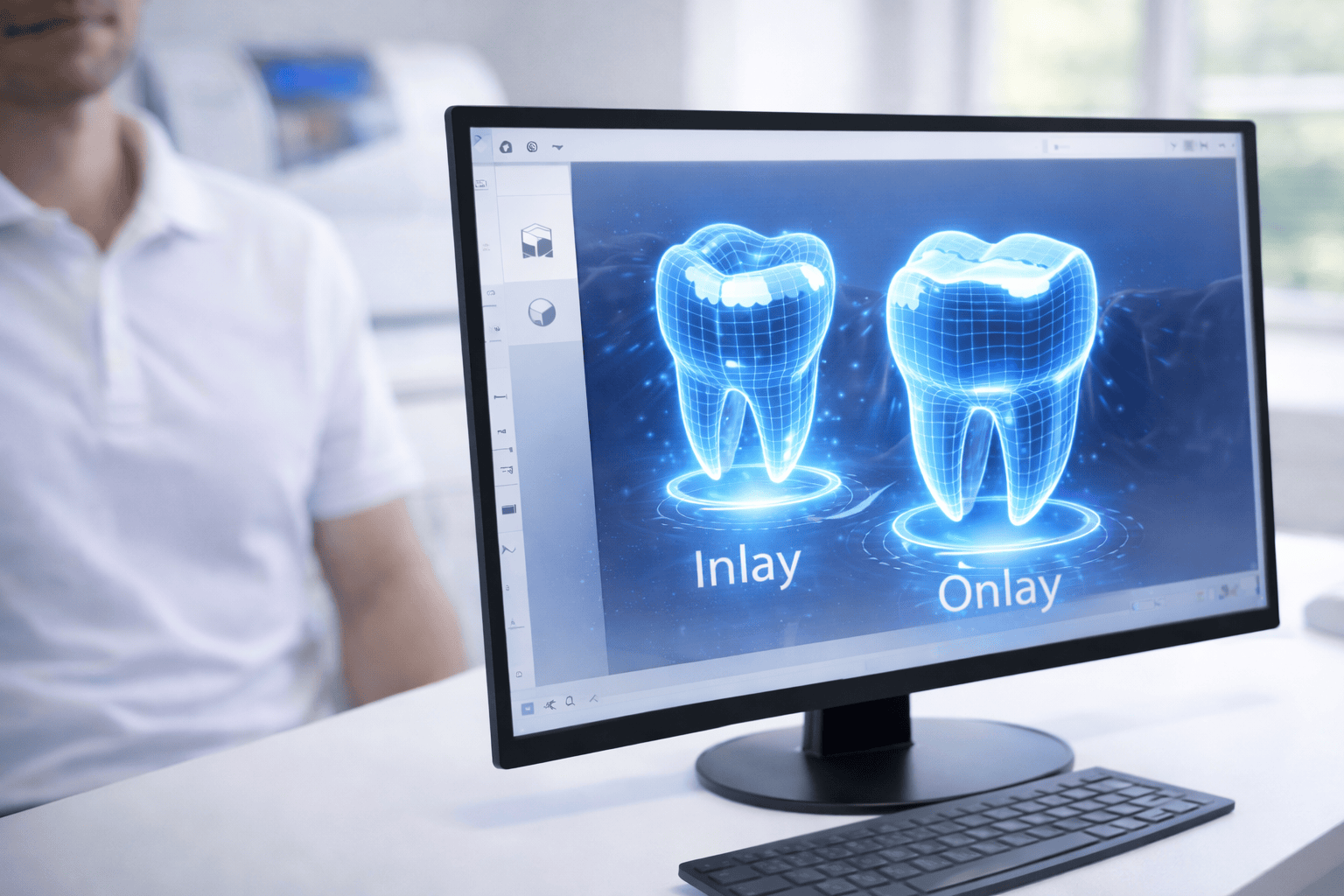
When a tooth is damaged by decay or a fracture, a full crown is not always the only solution.
In certain situations, a partial restoration called an inlay or onlay allows more of the tooth structure to be preserved while ensuring strength and durability.
With digital dentistry, these restorations can now be designed and manufactured with great precision — sometimes in a single visit.
But in which cases is it actually recommended?
What is the difference between a crown and an inlay/onlay?
The crown
It covers the entire visible surface of the tooth.
It is indicated when the remaining structure is insufficient to guarantee strength.
The inlay / onlay
- An inlay restores the interior of the tooth.
- An onlay covers one or more cusps without completely surrounding the tooth.
The goal is conservative: to preserve as much healthy tooth tissue as possible.
When should you choose an inlay or an onlay?
This solution is appropriate when:
- the tooth is weakened but still structurally stable
- the loss of substance is localized
- the peripheral wall remains sufficient
- the occlusion is compatible
On the other hand, if the tooth is too weak, a crown remains the safer option.
What digital dentistry makes possible
Digital technology allows for:
- a precise 3D scan without impression paste
- computer-aided design
- in-office ceramic manufacturing
- immediate controlled adjustment
In well-defined cases, an inlay or onlay can be completed in a single session.
Advantages of a digital inlay/onlay
- Maximum preservation of the natural tooth
- Highly precise fit
- Biomechanical strength
- Natural aesthetics
- Possible reduction in the number of appointments
However, technology does not replace medical indication.
Is it always possible in one visit?
No.
Treatment depends on:
- the condition of the pulp
- any potential inflammation
- anatomical complexity
- the occlusal context
The priority always remains biological stability and the longevity of the treatment.
Inlay, onlay, or crown: how to decide?
The decision is based on:
- the amount of healthy tooth remaining
- the location of the lesion
- masticatory forces
- the risk of fracture
The goal is not to choose the “fastest” solution,
but the most appropriate one.
Conclusion
A digital inlay or onlay represents a conservative alternative to a full crown when the right conditions are met.
Thanks to digital workflow, these restorations can be produced with precision and sometimes in a single visit.
If you are in doubt, a consultation can prevent complications from developing. Cabinet dentaire à Montreux : Dental Swiss Clinics.