
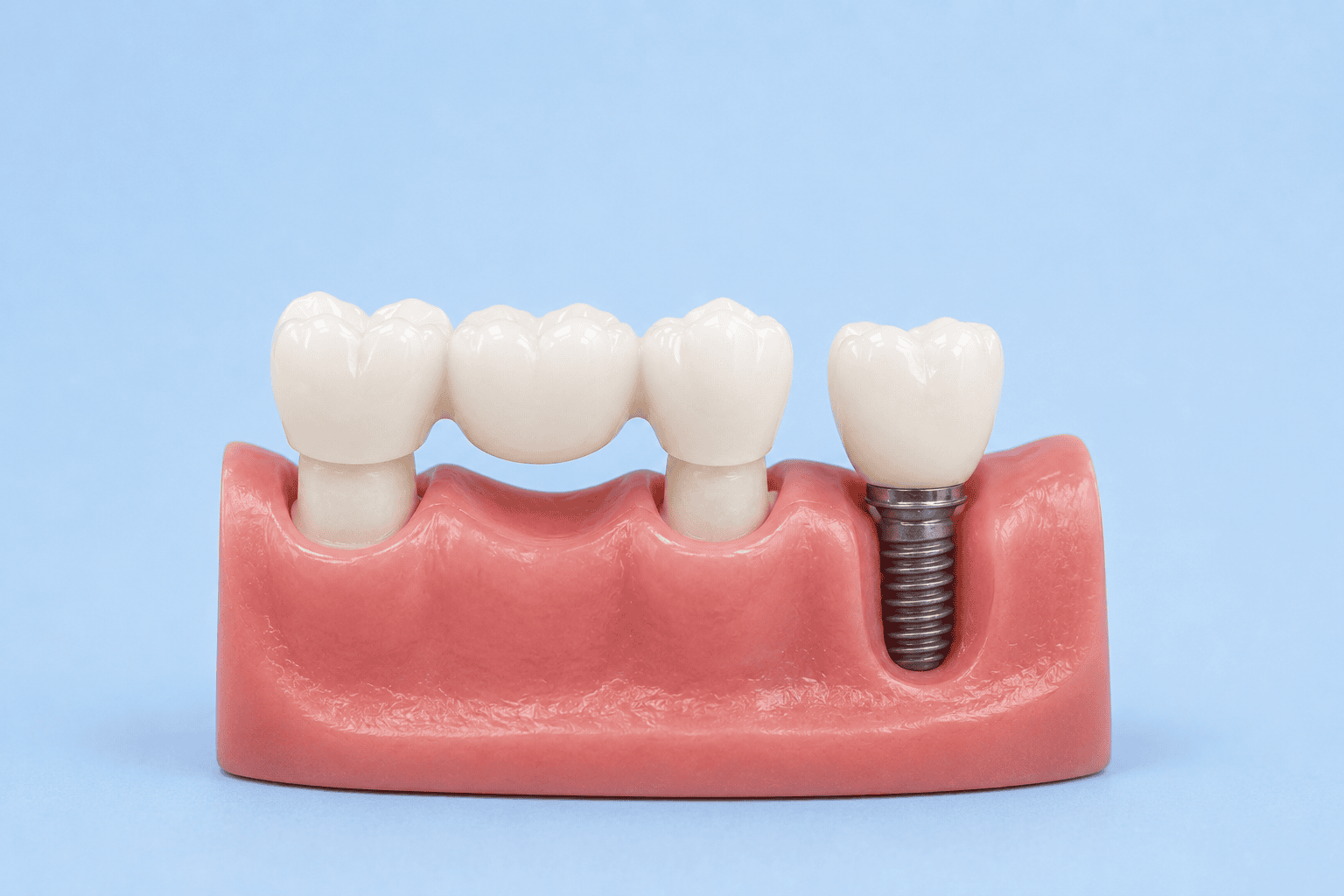
When a tooth is lost or condemned, two fixed solutions exist: the implant with a crown, or the bridge that relies on neighboring teeth.
The question I’m often asked during consultations: “Doctor, what’s better?” The honest answer: it depends. And sometimes, the best answer is to do nothing.
Here’s how Dr. Zerguine approaches the decision at Dental Swiss Clinics in Montreux.
The implant: the solution that preserves neighboring teeth
The implant replaces the lost root. A titanium screw is placed in the bone, then a crown is fixed on top. The principle is simple: only the missing tooth is replaced, without touching the healthy surrounding teeth.
This is the main clinical advantage of the implant. Neighboring teeth remain intact. They are neither prepared, loaded, nor stressed by the replacement solution.
At Dental Swiss Clinics, only Straumann group implants are used. Placement is performed in the practice, without xenograft, on healed sites in the vast majority of cases.
The bridge: a solution that involves neighboring teeth
The bridge replaces the missing tooth by relying on the two neighboring teeth, which become abutments. These two abutment teeth are prepared, meaning they are trimmed, then receive crowns integrated with an intermediate tooth that replaces the lost tooth.
It is a reliable and proven solution. But it comes with a compromise: two healthy teeth are prepared to replace one lost tooth. This is the point that must be faced before choosing.
In which cases do I recommend a bridge rather than an implant?
Contrary to what one might think, the bridge is not outdated. It still has specific indications, and in these cases, it often remains the right choice.
When the abutment teeth are already devitalized
If the neighboring teeth are already crowned or devitalized, preparing them for a bridge no longer represents the same biological loss. The clinical compromise is already in place.
When an anatomical obstacle prevents implant placement
Inferior alveolar nerve too close, maxillary sinus descended, insufficient bone volume without reasonable reconstruction possibility. In these situations, an implant would be a risky choice, and a bridge becomes the rational solution.
When the patient already has well-functioning bridges
A patient who has lived with bridges for years, without problems, with stable hygiene and occlusion, can certainly continue with this therapeutic approach.
When the periodontal situation is unstable
Neither an implant nor a bridge can be conceived on fragile foundations. Unstabilized periodontitis must be treated before discussing the prosthetic solution. Otherwise, failure is prepared.
In which cases do I recommend an implant?
Conversely, if the neighboring teeth are healthy and implant placement is possible, the implant is the solution I recommend. Preserving two healthy teeth is a fundamental clinical principle, and this solution guarantees the best long-term durability.
What about therapeutic abstention?
This is a point that is often forgotten to be clearly stated to the patient. If occlusal balance is in place, the patient is not requesting treatment, and there are no functional consequences to leaving the situation as is, doing nothing is a legitimate option.
Not all lost teeth need to be replaced immediately, or even at all. The therapeutic proposal must take into account the patient’s request, the existing balance, and the real expected benefit. Filling a space is not a necessity in itself.
What the long-term literature says
Your clinical practice is confirmed by long-term studies. 10-year data show a clear advantage for implants with single crowns: survival rates of 95 to 98%, compared to approximately 89% for conventional bridges over the same period.
The difference is not seen in the first few years, where both solutions perform well. It widens over time. The most frequent biological complications with bridges concern the abutment teeth: loss of pulpal vitality in about one-third of cases at 10 years, and decay on the abutments in nearly one in ten cases. These complications are non-existent with implants, which do not expose any neighboring teeth.
Over 15 to 20 years, the gap becomes significant. The implant continues to hold. The bridge often needs to be redone, which involves re-preparing the abutments and further weakening the teeth.
What it means for the patient
The choice is therefore not only made at the time of placement, but over the patient’s lifetime. An implant costs more initially, but avoids a replacement at 10-15 years. A bridge is sometimes less expensive immediately, but may require two or three successive replacements over a lifetime.
This is a reasoning I systematically share with the patient before proposing a solution. The choice must be understood, not endured.
At Dental Swiss Clinics, implant placement is offered from CHF 750, and the implant + crown package from CHF 2,050. The bridge is offered upon quotation, after clinical evaluation. See the prices page for details.
Frequently Asked Questions
Does an implant last a lifetime?
Scientific literature documents survival rates of 95 to 98% at 10 years. With good hygiene and regular follow-up, an implant can indeed function for several decades. The crown placed on it may require replacement, but the implant itself remains in place.
Is a bridge faster to make?
Yes, bridge placement takes a few weeks, without an osseointegration period. An implant, on the other hand, requires several months between placement and loading. But this time difference should not be the main decision criterion.
Can a bridge be replaced by an implant later?
Yes, but the reverse is simpler. Switching from a bridge to an implant requires a new bone evaluation, sometimes reconstruction. That’s why the initial decision deserves careful consideration.
What happens if a bridge abutment tooth becomes decayed or devitalized?
This is one of the most frequent long-term complications of bridges. Depending on the severity, it may require conservative treatment, devitalization, or sometimes complete replacement of the bridge.
Are all situations suitable for an implant?
No. Anatomical obstacles, unstabilized periodontitis, certain general medical contraindications, or an explicit patient choice can lead to a bridge. This is precisely why a complete clinical evaluation precedes any decision.
To assess your situation, contact Dental Swiss Clinics in Montreux, Monday to Friday from 8 AM to 8 PM.