
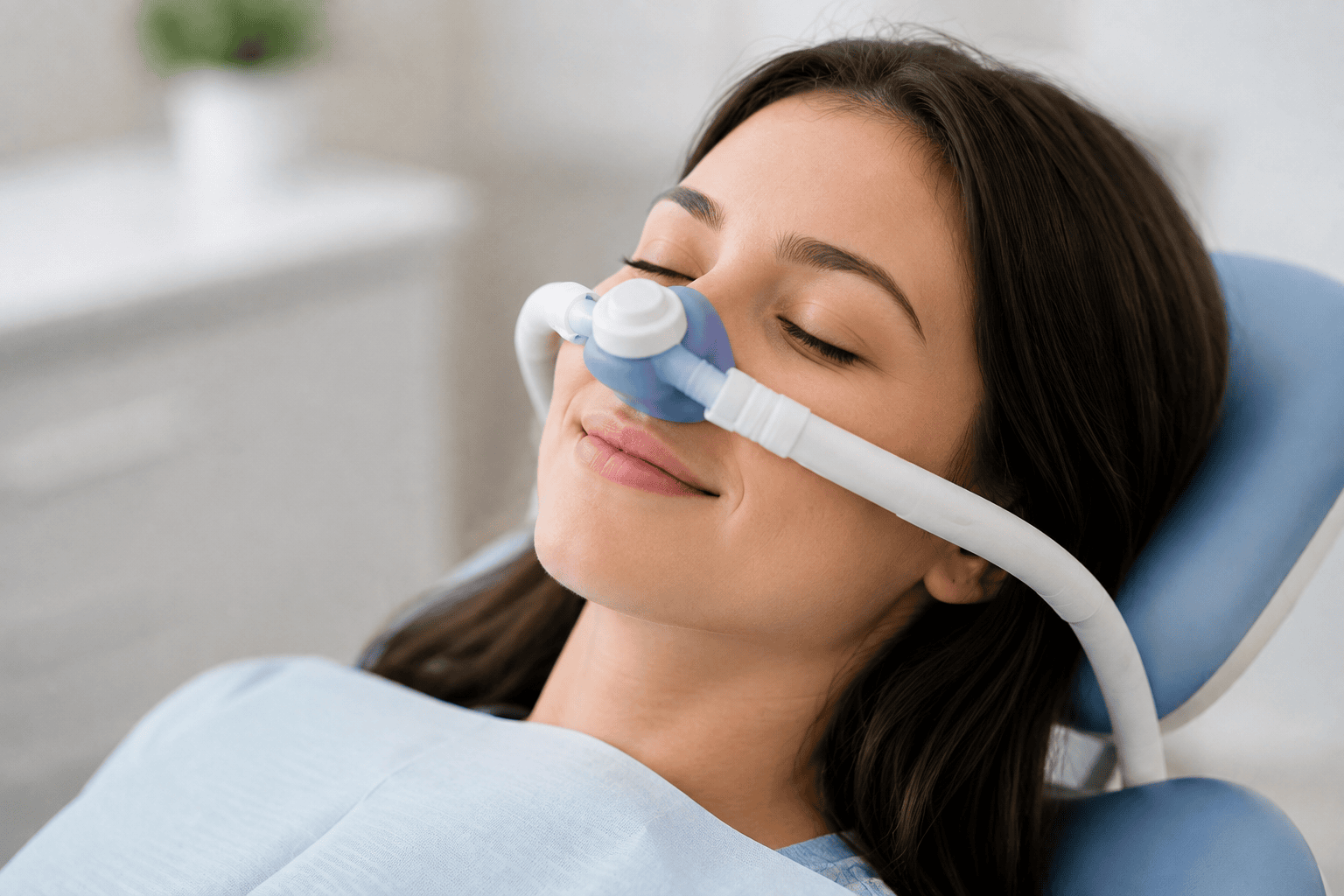
Conscious sedation is often presented as a miracle solution for patients who dread coming to the dentist. Some patients arrive for their appointment explicitly asking to be sedated before they even know what treatment they need.
My clinical position is more nuanced. Conscious sedation is a useful tool for specific indications. It does not replace the true foundation of a good therapeutic relationship: building trust, and helping the patient move from being a mere passenger to an active participant in their treatment.
Here is how I approach this question at Dental Swiss Clinics in Montreux.
What conscious sedation is
Conscious sedation is not general anesthesia. The patient remains conscious, able to communicate, and able to follow simple instructions. They are simply more relaxed, less anxious, and less reactive to stimuli.
At the clinic, we use a titrated mixture of nitrous oxide and pure oxygen. This differs from pre-mixed MEOPA (a fixed 50/50 nitrous oxide–oxygen blend) because we can precisely adjust the concentration to the patient, their age, the procedure being performed, and their level of anxiety.
Nitrous oxide works quickly. Its effects wear off within minutes after the gas is stopped. The patient can leave the clinic on their own, resume normal activities the same day, and drive if needed. These properties make this sedation particularly well suited to outpatient dentistry.
Who I offer conscious sedation to
In my practice, sedation at the clinic is mainly aimed at one group: children.
For children
A child who has not yet built a relationship with dental care, who has no reference points, and who experiences every gesture as an intrusion can genuinely benefit from conscious sedation. It allows necessary treatment to be carried out under good conditions, without creating a lasting negative experience that could compromise future care.
This is particularly relevant for children who struggle to remain cooperative during long appointments, or when several treatments need to be done in a single visit.
Who I do not offer sedation to as a first-line option
My approach to anxious adults is different. For these patients, my first-line proposal is not immediate sedation. It is the gradual building of a relationship of trust.
In practical terms, when an anxious adult comes in, I don’t jump into a complex procedure under sedation. I start with simple, low-stakes care that lets the patient see that coming to the clinic doesn’t unfold the way they imagined. A scale and polish, a check-up, a small filling. These first appointments gradually build trust.
Once that trust is established, more complex treatment becomes possible without needing sedation. A patient who has had several positive visits arrives in a very different emotional state from someone coming for the first time with all their fears.
This approach takes more time than immediate sedation. It delivers a more lasting result, because it turns the patient into an active participant in their care journey, not a passive spectator of treatment they simply endure.
The real goal: moving from passenger to active participant
This is the point that matters most to me in this reflection.
A sedated patient still experiences treatment passively. They are relaxed, they feel less, but they have not built their ability to understand, accept, and integrate the treatment.
A patient who has built trust with their clinician, who understands what will happen, and who has accepted the treatment with full awareness becomes an active participant in their own care. They cooperate. They value the result. They follow post-operative instructions. They come back without apprehension.
This difference is not cosmetic. It durably changes how the patient relates to their oral health—and therefore the quality of care they can receive throughout their life.
When sedation becomes useful for adults
My position is not dogmatic. Conscious sedation can be offered to adults in certain specific situations.
Long, complex procedures in a patient who remains anxious despite trust being established
When a patient has done the work of coming in several times, trust has been built, but a particularly long or complex procedure still feels hard to consider without help, sedation becomes a reasonable option.
Prolonged implant surgery
Some lengthy surgeries benefit from a particularly relaxed patient, both for their comfort and for the smooth execution of the procedure.
Strong gag reflex
Some patients have a gag reflex that makes treatment of the back teeth difficult. Nitrous oxide sedation can help control this reflex.
Persistent refusal of care despite an established relationship of trust
Some deep phobias are not resolved by the relationship alone. In these cases, sedation can be a last-resort tool to allow the patient to access the care they need.
What I don’t do
I do not sedate an adult patient simply because they ask for it before they have even tried a standard consultation.
I do not offer sedation as a sales argument or as an easy way out that avoids building a real clinical relationship.
I do not see sedation as a substitute for the time spent listening, explaining, and supporting—an integral part of my work.
Limits and precautions
Nitrous oxide conscious sedation is generally safe, but it is not without contraindications.
Certain medical situations require caution: significant nasal obstruction, severe lung disease, first-trimester pregnancy, and certain neurological conditions. A prior clinical and medical assessment is essential.
For children, sedation is carried out using protocols adapted to age and weight, with rigorous monitoring throughout the procedure.
Frequently Asked Questions
Is nitrous oxide conscious sedation the same as general anesthesia?
No. Conscious sedation keeps the patient awake and able to communicate. They are simply more relaxed. General anesthesia puts the patient into a deep sleep with loss of consciousness, which is not necessary for the vast majority of dental treatments.
How long do the effects of nitrous oxide last after treatment?
The effects wear off within minutes after the gas is stopped. The patient can leave on their own, resume activities, and drive the same day. This is one of the major strengths of this technique.
Do you need any special preparation before a sedation appointment?
A light fast for a few hours is recommended before the appointment. A prior medical assessment is carried out to confirm there are no contraindications. No specific medication preparation is necessary.
Can an anxious adult ask for sedation directly?
They can ask for it, but my first-line approach is different. I prefer to start with simple care to gradually build a relationship of trust. Sedation becomes an option if anxiety persists despite this pathway, or for particularly complex procedures.
Is conscious sedation covered by insurance?
It depends on the insurance policy and the clinical indication. An in-consultation assessment helps confirm feasibility and the coverage conditions in each case.
For an assessment of your situation or your child’s, contact Dental Swiss Clinics in Montreux, Monday to Friday from 8:00 AM to 8:00 PM.