
DIGITAL DENTISTRY • CLINICAL PRECISION • MONTREUX
For decades, a dental crown followed the same path: impression, temporary, laboratory, return to the office a week later. This protocol was the norm — not because it was optimal, but because no serious alternative existed.
Since integrating CEREC into my practice in 2013, this reality has changed. Not gradually — radically.
Here is what scientific literature confirms and what my patients experience firsthand at the Dental Swiss Clinics office.
What a dental laboratory actually does
A dental laboratory manufactures restorations from an impression — traditionally silicone, increasingly digital. The dental technician works on a plaster model or a 3D file to sculpt, sinter, or machine the final piece.
It is a craft of art and precision. The best laboratories produce pieces of remarkable aesthetic quality — particularly for complex cases with high visual requirements.
The average lead time in my practice: one week. Two appointments minimum. A temporary in between — fragile, less comfortable, and a potential source of sensitivity.
What CEREC actually does
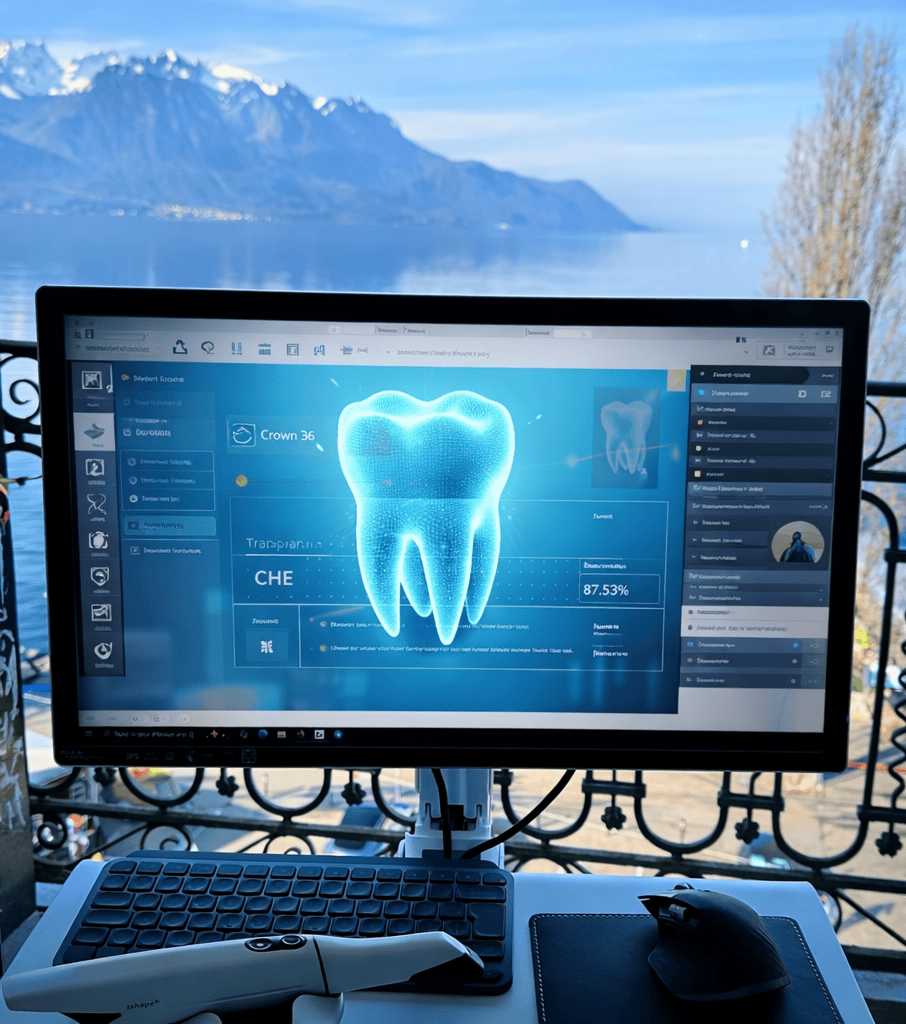
CEREC is a computer-aided design and manufacturing system — 3D intraoral scan, on-screen design, and direct in-office machining in ceramic.
No silicone impression. No temporary. No intermediary laboratory. No second appointment in the majority of cases.
The restoration is designed, machined, and fitted during the same consultation — generally in less than 2.5 hours. To better understand the possibilities of digital dentistry, visit our dedicated page.
The question of precision
This is often the patients’ first doubt: “Can a crown made in two hours at the office be as precise as a piece manufactured in a laboratory?”
The answer is in the scientific literature — and it is clear.
CEREC restorations show adaptation margins in the range of 10 microns with current protocols. This is a level of precision that I have personally never obtained as consistently with any laboratory — including the best ones I have worked with.
Since adopting my new protocols two years ago, I haven’t encountered a single case where CEREC’s precision was lacking.
When I still send work to the laboratory
I have worked almost exclusively with CEREC for several years. One case remains where I call upon the laboratory: patients with very high aesthetic requirements regarding color shading or translucency — beyond what digital technology can reliably reproduce.
In these very specific situations, the manual work of an experienced dental technician can provide an artistic dimension that even the best CAD-CAM system does not yet perfectly replicate.
These are rare cases. For the vast majority of patients — crowns, inlays, onlays, veneers — CEREC offers superior precision, reliability, and comfort compared to the traditional protocol.
What this means for you in practice
| Parameters | Laboratory protocol | In-office CEREC |
|---|---|---|
| Number of appointments | 2 minimum | 1 |
| Lead time with temporary | ~1 week | None |
| Fit precision | Variable | ~10 microns |
| Risk with temporary | Possible sensitivity | Eliminated |
| Dr. Zerguine’s involvement | Partial | Complete — scan, design, fitting |
What this means for the quality of care
In a full digital workflow, the practitioner treating you is also the one designing your restoration. There is no intermediary, no loss of information between the impression and the final piece, and no delegated decision-making.
This is a fundamental difference — not just in terms of comfort or speed, but of direct clinical responsibility for every restoration.
For anxious patients, the absence of a temporary and the reduction in the number of appointments is often a determining factor in their care experience.
Frequently Asked Questions
Is the aesthetic quality comparable? For the vast majority of cases, yes. Les céramiques utilisées avec CEREC sont des matériaux de haute qualité, bien documentés cliniquement. Pour les cas à exigence esthétique très élevée, un laboratoire spécialisé reste une option que je propose lorsque c’est médicalement et esthétiquement justifié.
Is CEREC suitable for all types of restorations? No — like any tool, CEREC has specific indications. Implants, complex multi-unit bridges, or situations requiring biological temporization may require a different approach. Each situation is evaluated individually.
Is the cost different? Fees reflect precision, technology, and clinical time — not the manufacturing channel. A personalized quote is provided after an examination.
How long have you been using CEREC? Since 2013 — before this technology became common in French-speaking Switzerland. Over ten years of treated cases, refined protocols, and documented results.