
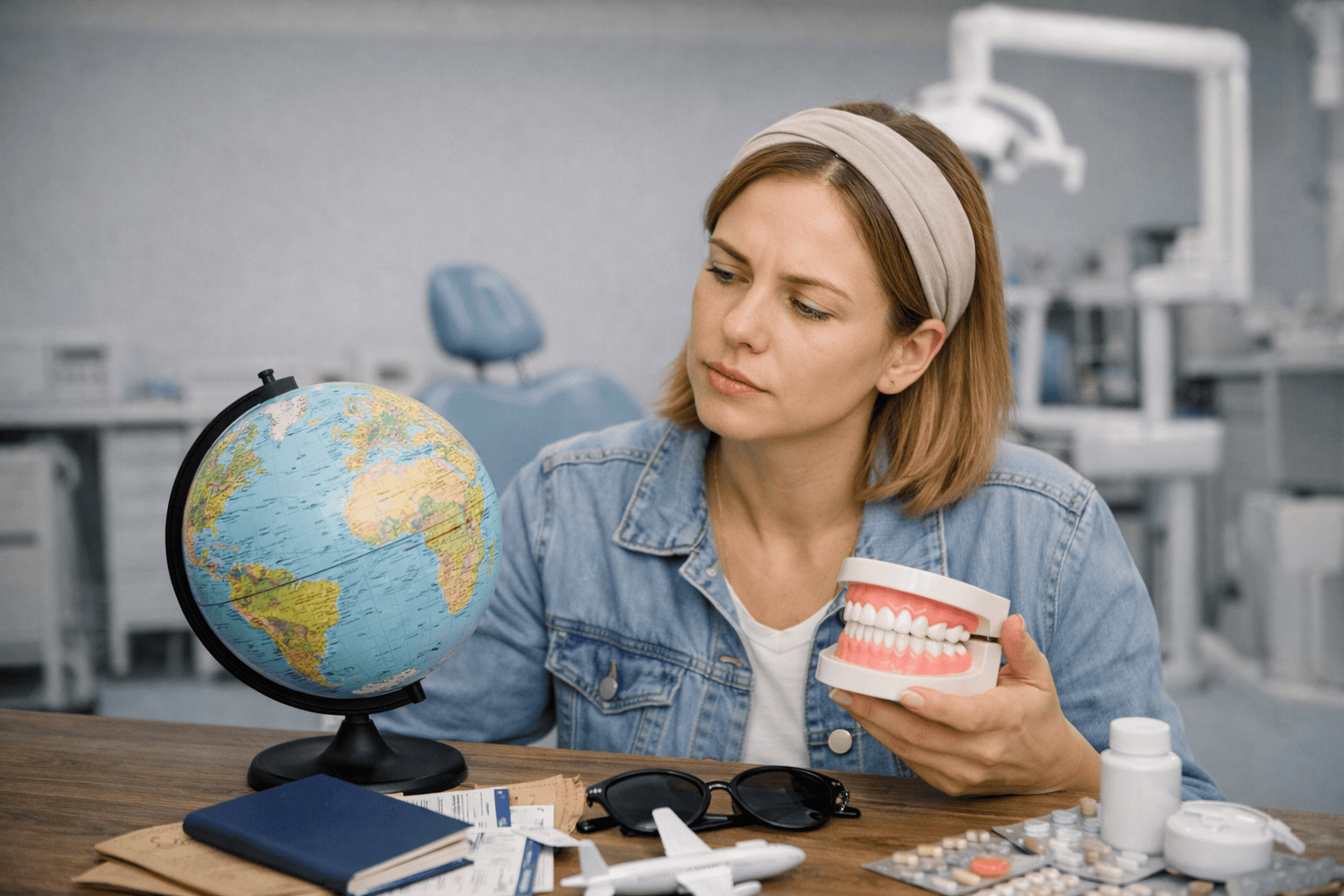
Every year, thousands of European patients choose to seek treatment abroad—particularly in Turkey—for perfectly legitimate economic reasons. The price difference is real and significant. The stay can be pleasant. And for certain treatments, the result is satisfactory.
I am not here to judge this choice. I treat all patients who need it—including those who return with complications. It is not up to me to decide under what conditions a patient deserves care.
But I see things in my practice that patients wish they had known before they left. It is for them that I am writing this article—not to dissuade them, but so they leave informed.
The economic logic is real—and legitimate
A full smile—20 to 24 teeth treated—is financially inaccessible for many patients in Switzerland. The cost of such treatment can reach tens of thousands of francs.
In Turkey, the same treatment costs a fraction of the Swiss price. When adding the hotel and flight, the patient often makes a substantial saving—and without private supplemental dental insurance, they pay out of pocket anyway, whether in Switzerland or abroad.
This logic is rational. Patients, like all economic agents, make decisions that make sense in their context. It would be a mistake to claim otherwise.
What I see clinically afterwards
Patients who come back to consult me after treatment in Turkey often present similar situations.
Pain when chewing
The occlusion—the way the teeth meet—has been significantly altered across the entire dentition. Reconstructing 20 teeth in one week without allowing time for the neuromuscular system to adapt can generate chronic pain when chewing. This is what is known as desmodontitis—inflammation of the ligament surrounding the tooth. It is painful and takes a long time to treat.
Systematic root canals
To avoid post-operative pain—inevitable when so many teeth are prepared in such a short time—some practitioners systematically perform root canals on teeth before placing crowns. The patient no longer feels anything. It is comfortable in the short term.
But a devitalized tooth is a weakened tooth. Multiplying root canals on teeth that did not necessarily need them clinically is a long-term risk that the patient has not always fully weighed before giving their consent.
Splinted restorations
Many of these treatments involve bridges that splint several teeth together. If one element fails or fractures, the entire reconstruction is often compromised. Redoing this type of work is not a minor task—the risk of fracture and complications is real.
What nobody explains before departure
The situation in case of complications
The majority of patients who choose care abroad do not have private supplemental dental insurance in Switzerland. They pay out of pocket—whether in Turkey or in Switzerland. The savings achieved are therefore real and direct.
The real problem appears in case of a complication. If something goes wrong upon return, the patient has two options: return to Turkey for a correction, or find a Swiss practitioner willing to intervene.
This second option is harder than it seems. In my practice, I find that many colleagues hesitate to intervene on reconstructions performed abroad. The reason is simple: taking over work that one did not perform makes the new practitioner responsible for the overall result. This is not a refusal out of ill will—it is a clinical and professional reality.
The patient then finds themselves in a difficult position: real complications, and local practitioners in an uncomfortable situation to intervene. Some do it—out of a sense of duty to humanity. Others cannot—due to real professional constraints.
Long-term follow-up
Treatment of this magnitude requires regular follow-up over years. This follow-up will not be provided by the clinic that performed the care thousands of miles away. It must be managed locally—with all the difficulties that implies when the Swiss practitioner does not have full visibility of exactly what was done.
The psychological dimension—rarely addressed
Radically transforming your smile in one week is an irreversible decision.
Some patients I see in consultation tell me, a few months after their return, that they no longer recognize themselves. The smile is too white, too uniform, too far from who they were. This is not a technical problem—it is an identity problem.
Psychologically preparing a patient for such a radical change takes time—aesthetic trials, simulations, discussions. This time does not exist in a one-week protocol.
An honest nuance
I must say something that few Swiss practitioners admit.
Clinics that perform these complex treatments in large quantities develop real expertise in multidisciplinary cases. Treating 20 teeth simultaneously, managing a global reconstruction, anticipating complications—this is a skill developed through practice.
Conversely, Swiss practitioners who never do these cases—because they are financially inaccessible for their patients—gradually lose the ability to perform them and to evaluate the real difficulties involved.
This is not a criticism. It is an honest clinical reality.
Questions to ask before you go
If you are considering care abroad—here is what I recommend you clarify before signing anything:
- How many teeth will be treated and why this precise number?
- How many teeth will have root canals—and based on what clinical criteria?
- What is the long-term follow-up plan once back in Switzerland?
- Who handles corrections if the result is not satisfactory?
- Did you have time to visualize the aesthetic result before validating?
- Do you have a Swiss practitioner ready to provide follow-up upon your return?
These questions are not there to dissuade you. They are there so that your decision is informed.
What I do in my practice
I see all patients who need it—including those who return with complications after care abroad. It is not up to me to judge my patients’ choices.
If you have questions before making a decision, a consultation at Dental Swiss Clinics will allow you to get an independent clinical opinion on your situation.
Frequently Asked Questions
Can you trust Turkish dentists? This is not the right question. Skill level exists everywhere. The real question is: is the proposed protocol—its scope, speed, and indication limits—suited to your specific clinical situation?
Is one week enough for a full treatment? Clinically, a large-scale treatment takes time — for biological adaptation, occlusal adjustment, and aesthetic validation. A week is a short timeframe for this type of reconstruction.
If I have complications when I return, who can help me? Consult a Swiss practitioner promptly. The earlier complications are addressed, the more correction options are available. Don’t wait for the situation to get worse.
Does Dental Swiss Clinics offer this type of full treatment? We perform reconstructions using digital dentistry in Montreux. Each case is evaluated individually—without diagnostic limits imposed by a commercial protocol. A consultation allows us to define what is clinically justified in your situation.