
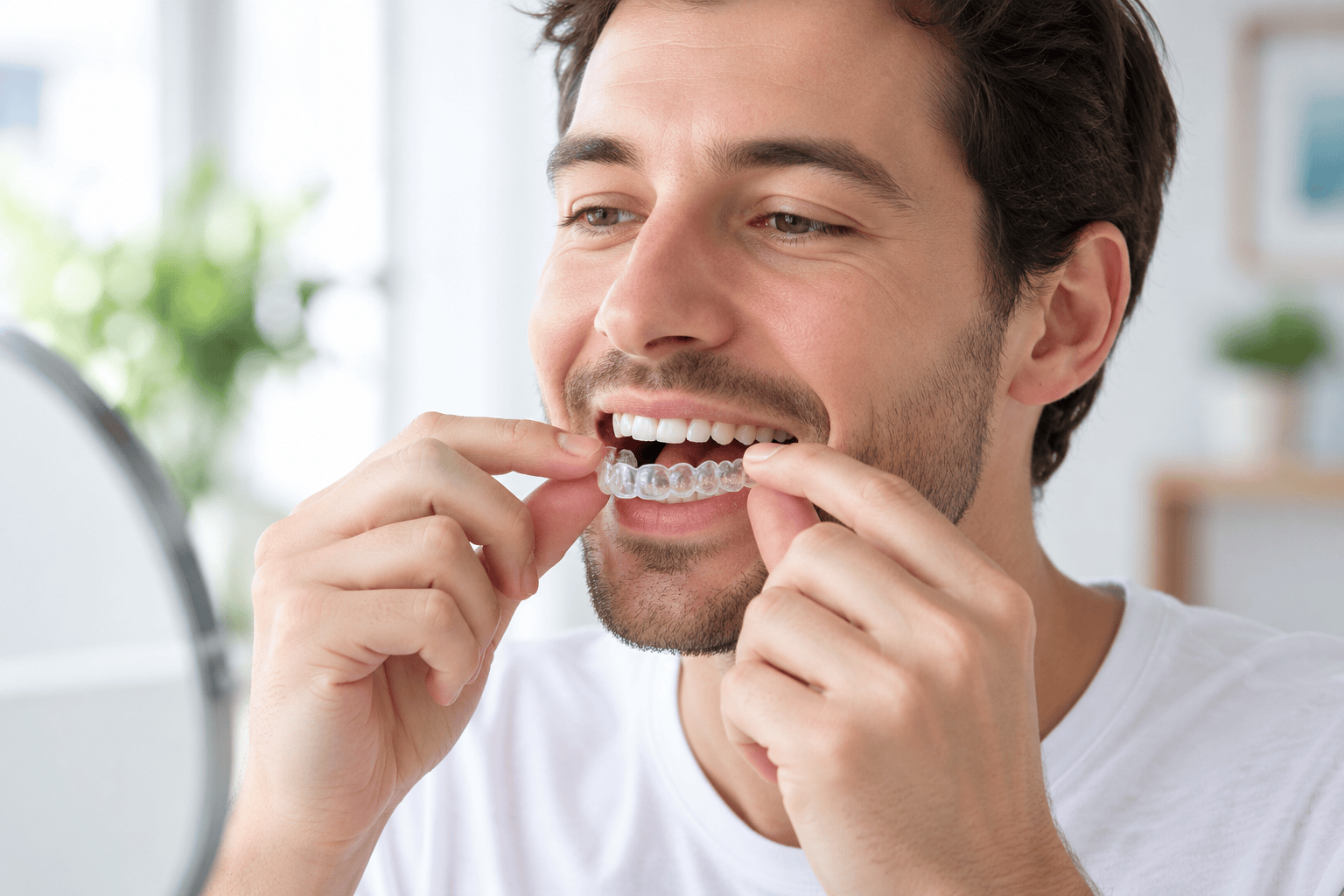
Dental aligners have become the most requested orthodontic option for adults. Discreet, removable, and aesthetically acceptable for daily life, they appeal to patients who would never have considered traditional braces.
This popularity is justified, but it has created a misconception: that aligners can treat everything. The clinical reality is more nuanced. Here is my position at my practice, Dental Swiss Clinics in Montreux, rooted in recent scientific literature.
What patients often ask
During consultations, most patients seeking aligners base their request on one observation: “My teeth are not aligned.” This phrasing often hides incomplete reasoning.
The underlying idea is that misaligned teeth can simply be put back in order by pushing them into their ideal position with trays. This reasoning overlooks a fundamental question: is there enough room for this realignment?
In many situations, dental crowding is not just a position problem; it is a space problem. Without creating additional space, moving the teeth is not possible. This space can be created by several means (interproximal reduction, extraction, arch expansion), but it must be discussed before treatment, not ignored.
This is one of the most misunderstood points for patients, and it is often the first topic to address during a consultation.
When aligners are a good solution
Aligners work well for a specific type of patient and clinical situation.
Minor alignment issues
Moderate crowding (generally less than 5 mm), slight spacing, aesthetic smile corrections. Clinical studies confirm that aligners achieve good results in these situations.
Absence of skeletal discrepancy
When the problem is purely dental, without significant skeletal disharmony between the maxilla and the mandible, aligners can provide the expected correction.
Motivated and cooperative patient
This condition is absolutely essential. Aligners must be worn 20 to 22 hours a day, every day, for the entire duration of the treatment. A patient who removes them too often, forgets to put them back in after meals, or does not maintain the discipline, will not achieve the expected results. Patient motivation is the number one factor for success.
Seeking a discreet result
An adult in a profession where appearance matters, who has a visible social life, or who refuses the look of braces, finds aligners to be an aesthetically acceptable solution throughout the treatment.
When braces remain preferable
Conversely, several clinical situations make traditional braces objectively superior to aligners.
Significant dental rotations with extrusion
This is likely the most documented limitation. Systematic studies from 2024-2025 confirm that aligners have an average rotational accuracy of 65%, with particular difficulties on canines and premolars. A rotation greater than 20 degrees is considered a relative contraindication for aligners. Braces remain superior in this context.
Complex multi-directional movements
When several types of movements must be combined (rotation, extrusion, torque control), braces offer finer and more predictable control than aligners.
Significant skeletal discrepancies
A skeletal disharmony greater than 2 mm limits the effectiveness of aligners. These cases often require a classic orthodontic approach, or even associated orthognathic surgery.
Cases where cooperation is uncertain
A patient who is unsure of their discipline, has a disrupted lifestyle, or enjoys frequent meals, will have better results with fixed braces that do not require daily management.
Hybrid approach
In some cases, a combination of braces + aligners can be the best solution. Braces manage complex movements at the start of treatment, then aligners take over for the aesthetic finishing. This mixed approach is gaining ground in adult orthodontics.
My clinical position on the choice
When an adult patient consults me for orthodontics, my decision is based on several combined criteria.
First, a complete clinical and radiographic evaluation. Analysis of crowding, skeletal discrepancy, the nature of any rotations, and the space available or to be created.
Next, an evaluation of the patient themselves. Motivation, capacity for cooperation, professional and social constraints, and aesthetic expectations.
Based on these two evaluations, I propose the most suitable solution. Aligners when the situation is simple to moderate and the patient is motivated. Braces when the situation is complex or cooperation is uncertain. A hybrid approach for mixed cases.
This decision is not dogmatic. It is adjusted for each patient, based on their clinical reality and personal goals.
What Patients Often Don’t Know
Three points regularly come up in consultations and deserve to be stated clearly.
One, the actual duration of treatment
Aligner treatment for adults generally lasts between 6 and 24 months, depending on complexity. Patients often expect shorter durations. A simple case can be treated in 6 months; a moderate case often requires 12 to 18 months.
Two, retention is essential
After active treatment, retention is necessary to maintain the result. This retention can be fixed (a wire bonded behind the teeth) or removable (a tray worn at night). Without retention, the risk of relapse is real. It is a long-term investment, not just for the duration of the active treatment.
Three, results are not perfect in all situations
Clinical studies show that the average accuracy of aligners is around 65%. This means that adjustments and refinements are often necessary during treatment. The initial treatment plan is a goal, not an exact guarantee of the final result.
The link with my digital practice
The full digital workflow I use at the clinic finds a natural extension in aligner orthodontics. Intraoral scans, digital planning, and treatment monitoring by comparing 3D models all integrate into a clinical continuity consistent with my approach to restorative dentistry.
This clinical continuity allows for combined projects, where orthodontics prepares the ground for the aesthetic or functional reconstruction that follows. A patient needing minor orthodontic correction before a veneer project or aesthetic rehabilitation can be treated entirely at the clinic, without being referred to an external practitioner.
Frequently Asked Questions
How long does aligner treatment take for an adult?
Generally between 6 and 24 months depending on complexity. A simple case can be treated in 6 months, while a moderate case often requires 12 to 18 months. A consultation evaluation will provide a precise estimate for your situation.
Do aligners need to be worn all the time?
Yes, 20 to 22 hours a day. They are removed only for eating, drinking (except water), and brushing your teeth. Insufficient wear directly compromises the results.
Can all alignment problems be treated with aligners?
No. Aligners are effective for simple to moderate cases. Significant rotations, skeletal discrepancies, and complex multi-directional movements are better treated with fixed braces or a hybrid approach.
Are aligners painful?
They create a sensation of pressure, which can sometimes be uncomfortable, particularly in the first few days of each new tray. This sensation diminishes quickly. It is generally less uncomfortable than fixed braces.
Is retention necessary after treatment?
Yes, systematically. Without retention, the risk of relapse is real. Retention can be fixed (bonded wire) or removable (night tray), depending on the clinical situation and your preferences.
For an evaluation of your situation, contact Dental Swiss Clinics in Montreux: Monday from 8 AM to 8 PM, Tuesday to Friday from 8 AM to 6 PM.