
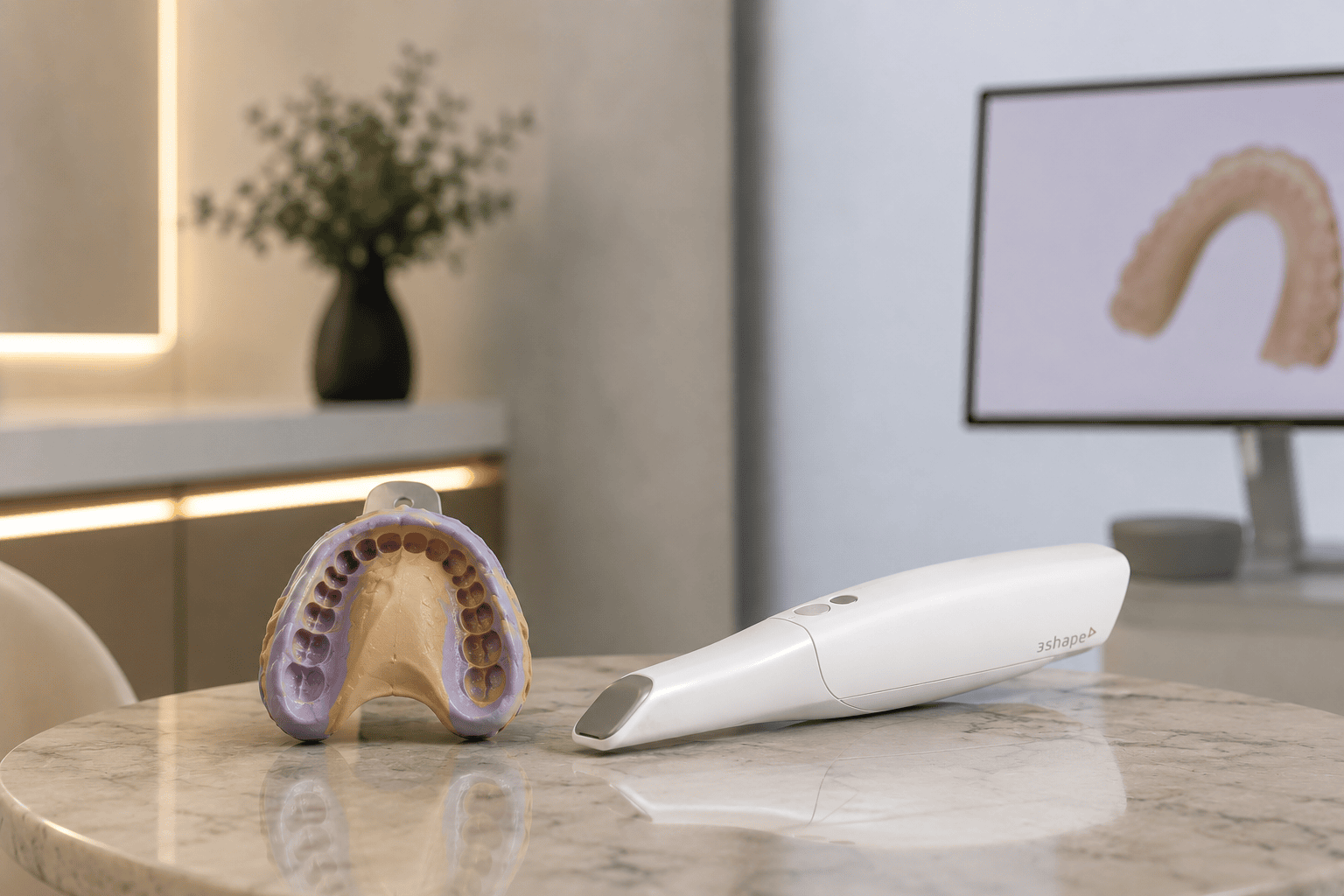
For decades, dental impressions meant trays in the mouth, cold material that hardens, a gag reflex, and an uncomfortable wait. For many patients, it is one of the least pleasant memories of a dental visit.
Today, this step almost no longer exists at Dental Swiss Clinics. Here is what has changed.
What a dental impression is
Before creating a crown, veneer, aligner, or mouthguard, the practitioner must have a precise reproduction of the patient’s teeth. This is the impression, the foundation of any restoration or dental appliance.
Traditionally, this impression was taken using a silicone material poured into a tray, inserted into the mouth, and held in place for several minutes until it hardened. The result was sent to the lab, which poured a plaster model. Several days would pass before the restoration could be manufactured.
What the intraoral scanner changes
The intraoral scanner completely replaces this procedure. A small, wand-like instrument captures thousands of images per second inside the mouth and reconstructs a 3D model of the teeth on a screen in real time.
No material, no tray, no waiting. The digital impression is completed in just a few minutes, right at the clinic.
At Dental Swiss Clinics, Dr. Zerguine uses the 3Shape Trios 5 scanner, one of the most accurate scanners on the market according to independent clinical studies published in 2024.
What patients experience
For many patients, their first experience with an intraoral scanner is a surprise.
They arrive with memories of silicone impressions: the material in the mouth, the discomfort, and sometimes the gag reflex. They leave with a radically different experience.
No discomfort, no cold material, no waiting. The practitioner passes the scanner over the teeth for a few minutes, and the 3D model appears on the screen in real time.
For anxious patients, this is often a turning point. Reducing sources of discomfort means reducing apprehension.
Precision: what the literature says
Precision is the most important clinical criterion for a dental impression. An imprecise impression leads to a poorly fitted restoration and complications.
Independent clinical studies published in 2024 rank the Trios 5 among the most precise scanners available. Accuracy values in the range of 37 to 55 microns have been documented—a clinical accuracy superior to what a silicone impression can consistently produce, even in the hands of an experienced practitioner.
This level of precision is particularly important for CEREC crowns, ceramic veneers, and implant-supported crowns.
When Dr. Zerguine still uses silicone impressions
The vast majority of cases are treated digitally. There are two situations where conventional impressions are still used at Dental Swiss Clinics: full removable dentures and certain repairs to existing removable dentures.
In these specific cases, the conventional technique remains the clinical gold standard. Outside of these indications, the scanner is the go-to solution.
How it changes the workflow
Digital impressions don’t just change patient comfort; they change the entire clinical workflow.
The 3D file is available immediately, without lab delays for a plaster model. It can be used directly for designing the restoration in the software, then sent to the milling machine or 3D printer at the clinic.
This is what makes it possible to create a ceramic crown in a single visit, from the digital impression to the final placement, without leaving the clinic.
Frequently Asked Questions
Is the intraoral scanner as accurate as a silicone impression? Yes, and in most cases, more accurate. 2024 clinical studies confirm that the Trios 5 produces consistently reliable results, with accuracy in the range of 37 to 55 microns.
Is the procedure long? No. A digital impression of a full arch typically takes 3 to 5 minutes, often faster than a traditional silicone impression.
Does it completely replace silicone impressions? In the vast majority of cases, yes. Certain specific situations, such as full removable dentures, still use the conventional technique when clinically justified.
Is the intraoral scanner suitable for anxious patients? Yes. The lack of material in the mouth and the speed of the procedure make it a particularly suitable option for anxious patients.
Which scanner do you use at Dental Swiss Clinics? The 3Shape Trios 5, one of the most accurate and reliable scanners available according to independent clinical studies published in 2024.
For a consultation at Dental Swiss Clinics in Montreux, Monday to Friday from 8 AM to 8 PM.