
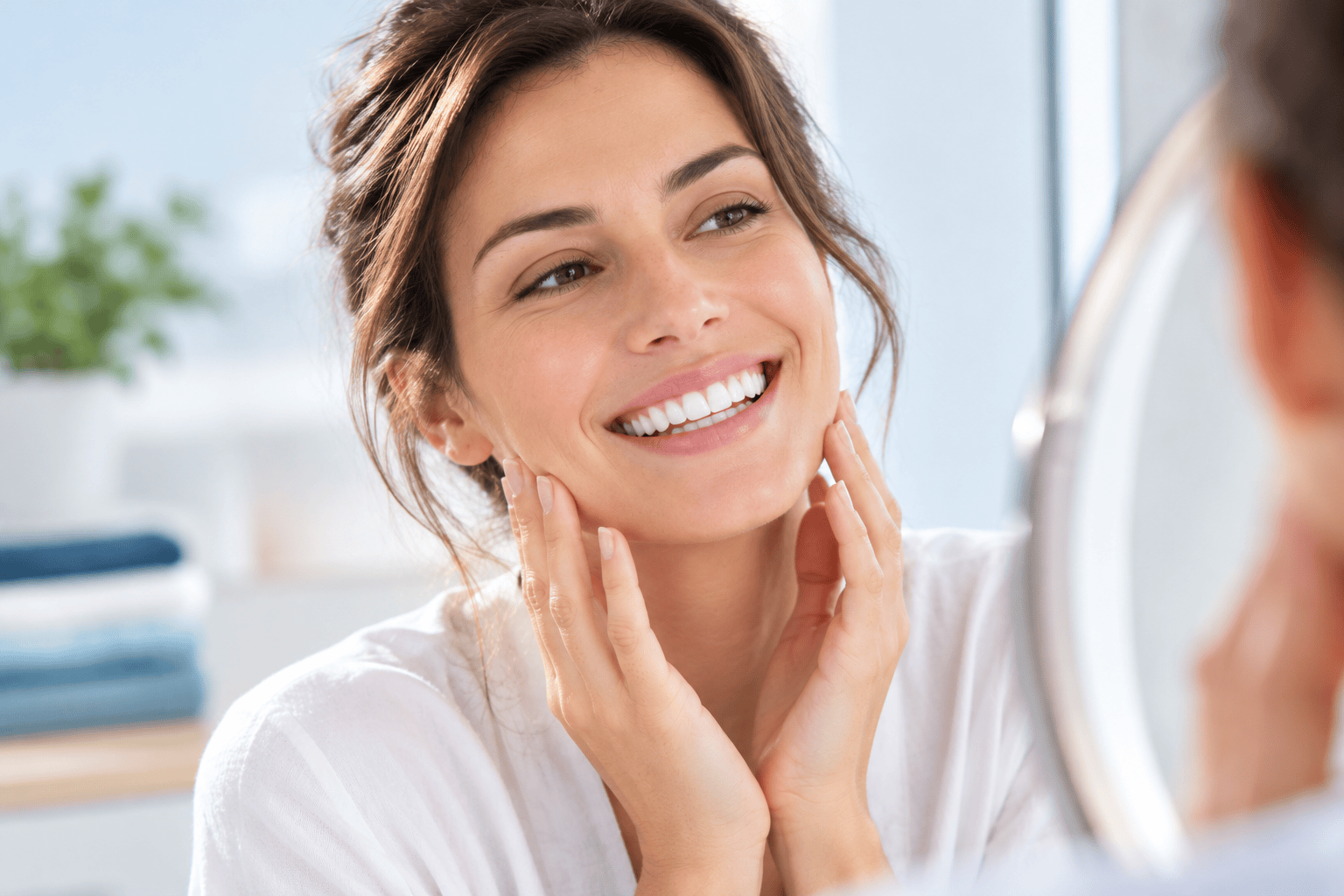
Teeth whitening is one of the most frequent aesthetic requests in the practice. It appeals due to its apparent simplicity and the promise of a brighter smile in a few days. The clinical reality is more nuanced. Whitening works well in the majority of cases, but not all. And it does not replace other treatments that aim for a deeper transformation.
My approach at Dental Swiss Clinics in Montreux is based on honesty: precise case evaluation before any treatment, a structured protocol for the right indications, and clear redirection when another solution would be more appropriate.
When Whitening Works Well
Whitening generally produces good results in most situations. It’s important to state this because some patients hesitate due to misconceptions about its ineffectiveness.
The best candidates for whitening are extrinsic discolorations and physiological yellowing.
Yellow Teeth
Contrary to popular belief, yellow teeth are among the best candidates for whitening. Scientific literature is clear on this point: yellow and brownish-orange shades respond best to hydrogen peroxide. The reason is technical: these discolorations are mainly located in the enamel and are accessible to whitening agents.
Food Stains
Coffee, tea, red wine, turmeric, red berries, and other coloring foods leave deposits on the enamel that respond well to whitening. The effect is often spectacular in heavy consumers.
Tobacco Stains
Tobacco deposits a brownish-yellow film that whitens well, provided the patient has reduced or stopped their consumption.
Age-Related Yellowing
Over the years, enamel gradually thins, allowing the naturally yellow dentin to show through more. Whitening can visibly enhance the brightness of the smile.
In these situations, an average gain of 2 to 4 shades is typical, sometimes more depending on the initial situation.
Situations Where Whitening Disappoints
Not all discolorations respond to whitening in the same way. Certain situations warrant a frank discussion before starting.
Gray Teeth
Gray shades respond poorly, or not at all, to whitening. These discolorations are often of deep intrinsic origin (tetracyclines taken during childhood, devitalized tooth with pulpal necrosis, deep dentinal stains). Peroxide does not reach these molecules trapped in the dentin. For these cases, other solutions exist (veneers, mock-ups).
Tetracycline Stains
Antibiotic treatments based on tetracyclines received during childhood can cause characteristic grayish or brownish bands. These discolorations are among the most difficult to treat. Whitening can sometimes slightly improve them, but rarely to a satisfactory degree.
Already Restored Teeth
Existing veneers, crowns, composites, and other restorations do not change shade with whitening. If a patient has crowns or veneers on their upper teeth, whitening only the natural teeth will create an unsightly contrast. In this case, the discussion should focus on a coordinated replacement of existing restorations with the desired new shade.
Unrealistic Expectations
Some patients arrive with a precise image in mind: the ultra-bright “bleach” shade they’ve seen in celebrity photos or on Instagram. This shade is not achievable with conventional whitening. It is obtained with ceramic veneers, which modify the color by covering the tooth surface. Confusing whitening and veneers leads to disappointment.
When an expectation is unrealistic, my role is to explain it clearly. The patient remains free to choose another approach (veneers, for example), but they must understand that whitening alone will not yield that result.
Our WHITE HOME Protocol
In the practice, I have developed a structured protocol called WHITE HOME. It is based on a simple specification: safe, effective, and with possible home maintenance.
Mandatory Preparation: Recent Scaling
A scaling must be performed at most one month before the start of whitening. This step is not optional. It ensures a clean tooth surface, free of tartar and superficial stains. Without this preparation, the whitening agent acts on a dirty surface, and the results are less uniform.
Custom Tray Fabrication with Digital Workflow
The trays are made from an intraoral scan, not a traditional impression. This precision ensures a perfect fit, preventing product leakage onto the gums and optimizing contact between the gel and the tooth surface.
Ambulatory Home Whitening
The patient wears their trays at home, following a precise protocol. Average treatment duration: 7 to 15 days. The variation primarily depends on the chosen strategy; the patient can treat the upper and lower teeth simultaneously (shorter duration, but adaptation to monitor) or treat them sequentially (longer duration, but more comfortable sensations).
Use of a Dedicated Toothpaste
Throughout the treatment, a specific toothpaste is used to prevent dentinal sensitivity. This precaution significantly increases patient comfort and avoids unwanted interruptions.
Golden Rule: Never Force It
If the patient experiences discomfort, marked sensitivity, or any other inconvenience, the treatment is paused for a few days. This pause is preferable to complete cessation. Whitening then resumes normally, without loss of effectiveness.
Possible Home Maintenance
The advantage of the WHITE HOME protocol is that the patient keeps their trays. After two months (or later depending on the result), they can perform a new application at home to maintain the achieved shade. This flexibility is particularly appreciated by patients who regularly consume coffee, tea, wine, or tobacco.
Why This Specific Protocol
Each step of the WHITE HOME protocol is based on current international recommendations.
Prior scaling is explicitly recommended by the German Federal Dental Chamber (BZÄK) before any whitening, regardless of the chosen method. This preparation is not a personal preference; it is a standard of good practice.
The 7 to 15-day duration is aligned with the reference method developed by Haywood and Heymann in the late 1980s, which remains the basis of most modern ambulatory protocols worldwide.
The structured prevention of sensitivities with dedicated toothpaste is confirmed by recent scientific literature as a significant factor in comfort and treatment adherence.
Home maintenance with retained trays is validated by long-term follow-up studies that show stability of results over several years when this protocol is followed.
This is not a proprietary protocol. It is the rigorous application of what international dental science recommends today.
Why I Prefer Ambulatory Whitening
In the practice, we do not perform “in-office” whitening in a single one-hour session. This approach exists and yields immediately visible results, but it has several drawbacks.
The high concentrations used in-office increase the risk of marked post-operative sensitivities. The result obtained in one session regresses more quickly in the following months. And no home maintenance is possible without returning to the practice.
Ambulatory whitening with trays, although longer, offers a more stable result, better management of sensitivities, and patient autonomy for future touch-ups.
Sensitivities: Reality and Management
Sensitivity is the most frequent side effect of whitening. It occurs in some patients, to varying degrees.
In the majority of cases, it remains moderate and transient. With our protocol (dedicated toothpaste, respecting the rhythm, pauses if necessary), it is well controlled.
When it appears, it generally disappears within 24 to 48 hours after temporary cessation of treatment. In very rare cases, treatment must be interrupted, and another approach discussed.
To learn more about tooth sensitivity and its management, see our dedicated article Tooth Sensitivity: Causes and Management.
What Whitening Is Not
Three clarifications to address the most common misunderstandings.
Whitening is not scaling
A scaling removes tartar and some superficial stains. It does not change the intrinsic shade of the teeth. A patient who wants a brighter smile after a simple scaling will be disappointed.
Whitening does not transform tooth shape
If the aesthetic goal goes beyond color (broken, worn, misaligned, or spaced teeth), whitening alone will not suffice. Ceramic veneers or other aesthetic rehabilitation approaches are then more suitable.
Whitening is not permanent
Dietary habits, tobacco, and physiological aging continue to act after treatment. Regular maintenance (an application every two to six months, depending on the case) is necessary to maintain the result long-term.
Frequently Asked Questions
How many shades can be gained with whitening?
On average, 2 to 4 shades on a tooth with a favorable initial shade (yellow, extrinsic stains). More in some cases, less in others, depending on the initial situation.
Does whitening damage enamel?
No, when performed according to a supervised protocol with appropriate concentrations. Enamel is not damaged by hydrogen peroxide used at ambulatory concentrations. The transient sensitivity experienced is not a sign of damage.
How long do the results last?
Between 6 months and several years, depending on the patient’s habits. Heavy consumers of coffee, tea, red wine, or tobacco will see their results degrade more quickly. Hence the benefit of our WHITE HOME protocol, which allows for autonomous home maintenance.
Can whitening be done during pregnancy?
No, as a precautionary principle. Whitening is postponed until after pregnancy and breastfeeding.
How much does WHITE HOME whitening cost?
Starting from CHF 429. A precise quote is established during the initial consultation, taking into account prior scaling and any associated care.
Can whitening be done if you have veneers or crowns?
Not directly. Existing restorations do not change shade. Either one accepts that only natural teeth will lighten (creating a contrast), or one considers a coordinated replacement of restorations with the desired new shade. This decision is discussed during consultation.
For an evaluation of your situation and a tailored plan, contact Dental Swiss Clinics in Montreux at 021 966 54 54 or via WhatsApp. Monday from 8 AM to 8 PM, Tuesday to Friday from 8 AM to 6 PM.