
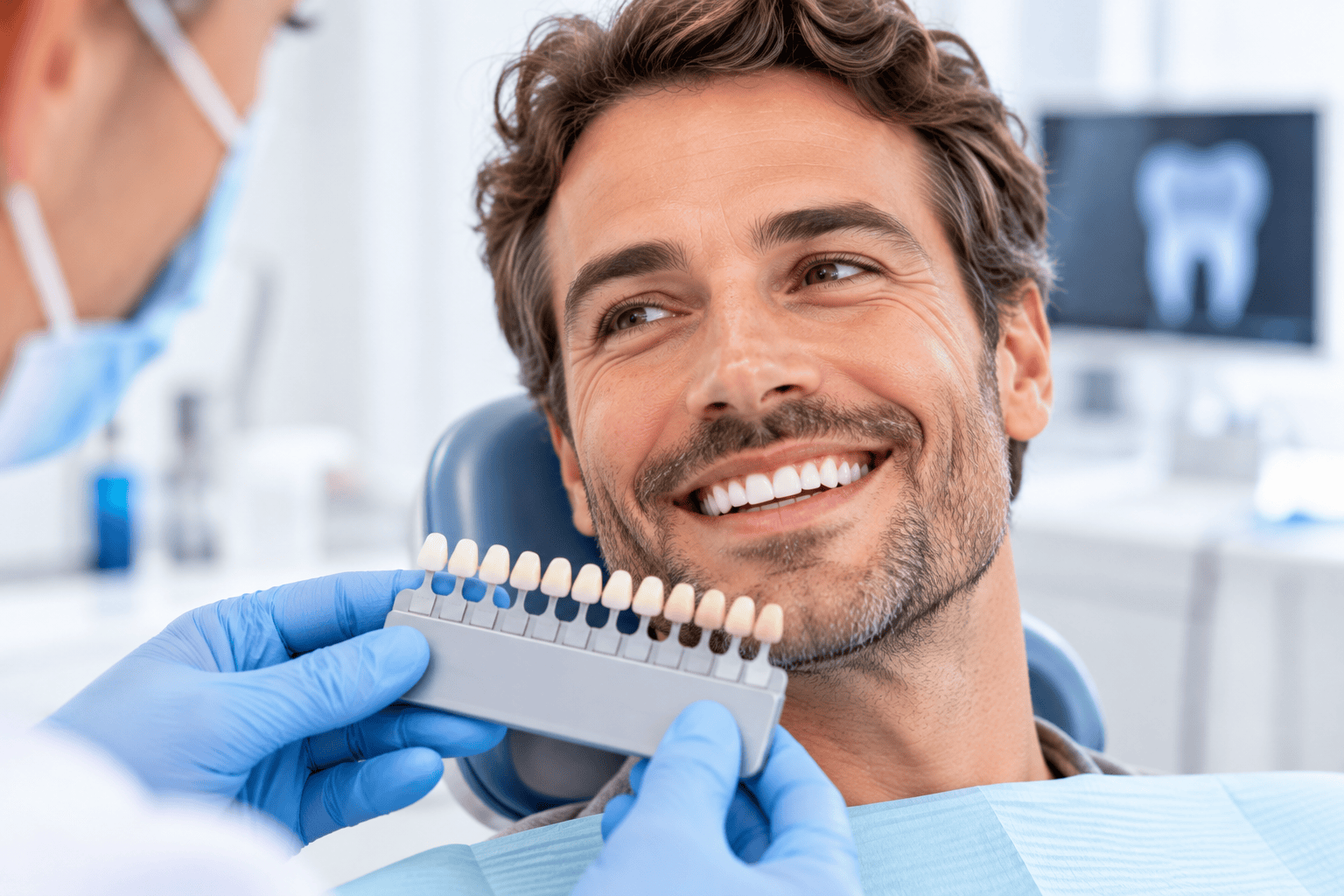
Ceramic veneers hold a unique place in aesthetic dentistry. They appeal through the promise of a transformed smile, yet they rely on precise clinical indications that not all practices communicate with full transparency. As a result, some patients arrive with unrealistic expectations, while others harbor hesitations rooted in misconceptions.
My approach at Dental Swiss Clinics in Montreux is clear: veneers are an exceptional solution when properly indicated, and an ill-advised choice when clinical conditions are unfavorable. The key lies in distinguishing between the two.
True indications for dental veneers
In my practice, ceramic veneers serve a well-defined purpose. They are primarily indicated in two situations.
First scenario: compromised dental aesthetics that cannot be resolved with direct composite
Certain teeth display morphology or defects that exceed the capabilities of direct composite restorations: teeth that are undersized relative to adjacent teeth, overall anatomy requiring redesign, deep discolorations resistant to bleaching, or aging restorations requiring replacement. In these instances, ceramic veneers provide a durable, high-end aesthetic solution.
Second scenario: high aesthetic expectations requiring long-lasting results
Some patients have very specific expectations: a transformed smile that remains stable over time without deteriorating year after year. While direct composite bonding can deliver an attractive initial result, it requires regular maintenance (polishing, touch-ups, partial replacement) and is prone to shade changes over the years. Ceramic provides superior stability.
For patients investing in a long-term result, ceramic veneers are an ideal solution.
An important clinical observation regarding composite
One point deserves clear explanation, as it directly shapes patient understanding.
In my practice, patients rarely ask spontaneously for veneers. Most aesthetic consultations begin with: “I want to improve my teeth without drilling them.” Veneers are often associated with irreversible tooth preparation, which creates hesitation.
What patients often do not realize is that direct composite bonding can also require tooth preparation. The difference lies not so much in the amount of enamel removed (which is sometimes comparable), but in how the process is perceived over time:
- Veneer: tooth preparation → impression taking → in-office fabrication → bonding. The patient observes each step, including preparation.
- Direct composite: preparation (if required) → immediate composite layering. The patient experiences a continuous procedure without intermediate stages.
Composite is not inherently more conservative than a veneer. It is simply perceived as such because the procedure takes place in a single session without a distinct, standalone preparation phase.
Understanding this is essential for informed consent. The real determining factor between composite and veneers is not the volume of altered tooth structure, but the desired longevity and the clinical constraints of the case.
Tooth preparation: prep vs. no-prep
Once the decision to place a ceramic veneer is made, the question of preparation arises: should the tooth be prepared or not?
No-prep veneers: when are they possible?
A no-prep veneer is indicated when a tooth is recessed relative to adjacent teeth. In this alignment, adding ceramic thickness to the surface restores ideal alignment without altering underlying tooth structure.
This applies to several clinical scenarios:
- Teeth positioned lingually or palatally (recessed)
- Spacing between teeth (diastemas) to be closed
- Microdontia or undersized teeth
- Minor orthodontic relapse with retroclined teeth
When these criteria are met, no-prep veneers deliver an aesthetic outcome without sacrificing enamel. It is the ideal approach whenever clinically feasible.
Prepared veneers: when are they necessary?
When teeth are already prominent, well-aligned, or slightly labially inclined, bonding ceramic without preparation would create unsightly, dysfunctional overcontouring. In such cases, minimal preparation is necessary to ensure harmonious integration of the veneer.
Modern preparation techniques remain strictly conservative: reduction is confined primarily to enamel (sparing dentin in standard cases), typically removing only 0.3 to 0.7 mm. The tooth remains vital, protected, and functional.
Clinical limitations to consider
Veneers are not a universal solution. Certain clinical situations contraindicate their placement, and a diligent clinician must know when to postpone or refuse treatment.
Uncontrolled bruxism
This is the most frequent contraindication in my practice. Clenching or grinding without a protective nightguard subjects teeth to excessive occlusal forces capable of fracturing ceramic.
Survival studies confirm a significant reduction in veneer longevity among bruxers. Before considering veneers in a patient who clenches, establishing a protective nightguard and stabilizing bruxism are non-negotiable prerequisites.
To learn more about bruxism, read our article Bruxism: Early Warning Signs.
Loss of vertical dimension
Some patients present with an occlusion compromised by loss of vertical dimension caused by generalized tooth wear. In such situations, placing anterior veneers alone will not resolve the issue, as the underlying problem is posterior.
Restoring anterior aesthetics without addressing the overarching occlusal etiology is bound to fail. The veneers will fracture under improperly distributed loads. These cases require full-mouth occlusal rehabilitation rather than isolated veneers.
Unfavorable occlusion
Beyond vertical dimension loss, certain occlusal relationships exhibit interferences, premature contacts, or imbalances that preclude long-term veneer stability. Occlusal analysis is an integral part of preliminary evaluation and may lead to temporary deferral or referral toward alternative therapies.
My clinical decision-making approach
When addressing aesthetic requests, my approach follows a structured pathway.
Step 1: understand true patient expectations
What specifically does the patient wish to improve? Color, shape, alignment, or a localized defect? Precise goals determine the appropriate solution.
Step 2: comprehensive clinical assessment
Occlusion, periodontal health, bruxism, vertical dimension, and posterior support. A veneer cannot be evaluated independently of the overall dentition.
Step 3: recommend the most appropriate solution
- If the aesthetic concern can be resolved through teeth whitening, whitening is proposed
- If direct composite bonding is sufficient, composite is recommended
- If veneers are the appropriate solution, we outline the procedure along with its clinical implications
- If clinical conditions preclude veneers, we explain why and suggest an alternative approach
Step 4: discuss expectations and limitations
A patient requesting an “ultra-bright bleach” shade with veneers must understand the scope of treatment. A patient expecting maintenance-free results must be informed of oral hygiene requirements and follow-up care.
What I do not do
I do not place veneers in the presence of uncontrolled bruxism.
I do not place 10 anterior veneers when the true requirement is full-mouth occlusal rehabilitation.
I do not perform veneer treatments simply “because the patient asked,” without thorough preliminary clinical evaluation.
Nor do I reject legitimate requests for veneers on the grounds that they are “purely cosmetic”: when clearly indicated, veneers are an outstanding treatment.
Frequently asked questions
Do veneers damage teeth?
No, not when performed according to sound clinical protocols. Modern preparation, when necessary, remains strictly conservative and preserves pulp vitality. No-prep veneers do not alter natural tooth structure at all.
How long do veneers last?
The average lifespan of properly placed ceramic veneers exceeds 10 to 15 years, and can extend well beyond with excellent oral hygiene and the absence of risk factors (particularly uncontrolled bruxism).
Can veneers be removed?
No-prep veneers are theoretically reversible, as the underlying dental structure remains intact. Prepared veneers are irreversible: the tooth reduction performed cannot be undone. This aspect must be fully understood prior to beginning treatment.
How much does a ceramic veneer cost?
Starting from CHF 800 per veneer. A detailed quote is provided during consultation, tailored to the number of veneers and clinical complexity. See Fees.
How many veneers are needed?
This depends on aesthetic goals and the smile line. Some cases require 2 veneers, while others need 4, 6, or 8. The choice is based on visible tooth exposure and desired aesthetic harmony, rather than a generic rule.
Can veneers be placed at any age?
Not before facial growth is complete and gingival margins have stabilized. For teenagers, it is advisable to wait until bone growth and gingival architecture have fully stabilized. In adults, there is no upper age limit provided overall oral health allows.
What is the difference between veneers and crowns?
A veneer covers only the facial surface of the tooth, preserving the vast majority of natural structure. A crown covers the entire tooth, which requires significantly more extensive preparation. Crowns are indicated when teeth are heavily broken down or endodontically treated, whereas veneers are chosen when teeth are sound or minimally restored.
For a personalized evaluation and tailored treatment plan, contact Dental Swiss Clinics in Montreux at +41 21 966 54 54 or via WhatsApp. Monday from 8 AM to 8 PM, Tuesday to Friday from 8 AM to 6 PM.